
As we approach National Poetry Day on 3rd October we focus on the work of one of our alumnae, Sarah Merriman. Sarah graduated in July 2024 with an MSC in Dementia Studies and runs her own Dementia Consultancy. Sarah also delivers freelance dementia training work to educate and train people about dementia: https://www.able-training.co.uk/
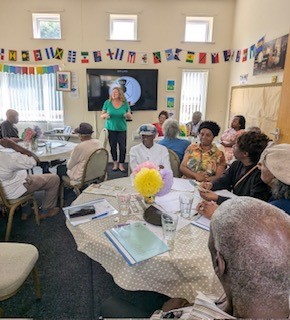
Sarah recently delivered a poetry session at the Sheffield Memory Hub who provide services that enhance the health and well-being of those living with forgetfulness, dementia, Alzheimer’s disease and other cognitive challenges. The Hub is a finalist in in the ‘Best Inclusive Dementia Care in our Diverse Society’ category at the National Dementia care awards held on 26th September.
Can you tell us about the session that you delivered and what it entailed?
I have written inspirational poetry for many years. Some of which has been published online and a few years ago I won a prize in a national poetry competition which spurred me on.
I took copies of 3 of my poems to the group and gave one of each to each person. I spoke about the power of poetry and reminiscence and then read each poem out loud and asked the group to comment as to whether it resonated with them or if they had any comments about the poems.
Research suggests poetry can improve short and long-term memory, listening skills and concentration in older people. Writing or reciting a poem can boost memory too, thanks to rhyme. How have you seen this impact in the work that you did at the Memory Hub?
The poems I read out provoked lively discussion amongst the group and then I asked them to have a try themselves to write either a short poem or a few lines about something that made them happy. Thoughts about their families or childhood growing up in the Caribbean, anything that evoked happy memories. They all did that and then quite a few of them read out what they had written which was lovely. They wrote about parents, childhood, friends , cooking at home… lots of different topics. As people recalled events from their childhood and family through the power of their words, it was easy to see the joy it brought and the memories that were stirred.
You have been active campaigner on the subject of dementia over the past few years including the #FrontOfMind Campaign launch in June 2022 in Parliament, speaking to MPs to engage them with Campaign for better diagnosis pathways for Dementia. Do you feel that we are moving forward in this area, and if not, what more do we need to be doing?
I have campaigned for many years for better dementia care in this country. I was the primary unpaid carer for my nana who developed dementia, and I cared for her for years until she died. It was the appalling experiences I encountered in my caring role that led to my career change into the field of dementia.
It is a passion of mine and my passion is my purpose. I don’t think the country has come nearly far enough in terms of standardised dementia pathways or post diagnostic support .
We now have ICS who will determine in each of the 42 areas what the dementia pathway will look like in each area. However, that will still leave room for a variation of service provision which is postcode dependant. This is not how it should be. You should be able to expect the same access to diagnosis and post diagnostic support whether you like in Scunthorpe or Southampton.
The fact that the country relies so heavily on family carers providing the majority of the post diagnostic support and care is another huge bugbear of mine. Family members give up time, family, careers to become full time carers and they receive no recognition from the government. Carers allowance is a pittance and nowhere near a living wage. They save the economy over £14 billion a year in the care they provide to their loved ones. If they all went on strike tomorrow, then this country would be on its’ knees in a matter of days. Primary Health care services, Hospitals and Social services would be stretched beyond breaking point.
Yet the government has yet again swerved the issue of social care. They have scrapped the idea of funding to train the social care workforce. They haven’t made dementia the priority it needs to be. It is the biggest killer in the UK. It is a life limiting complex condition that requires a well-resourced and well-trained workforce to provide the care that is necessary, but the government turns a blind eye and in silence, families struggle on behind closed doors as they are pushed beyond breaking point trying to keep going. It is nothing short of a national disgrace.
My caring role brought me to my knees , physically and mentally and there are hundreds of thousands of unpaid carers out there today still in exactly the same position as I was. It’s time that the tide turned and the government grasped the nettle once and for all and invested in the Health and Social care workforce and in providing services and support for families caring for their loved ones with dementia .
I will carry on campaigning and speaking out until I see a change.
Reflecting on your time at the University of Hull which aspects of your MSC Dementia Studies course do you think have been the most beneficial to your current career development and why do you think they have had that impact?
Completing my Master’s degree at Hull broadened my knowledge base and afforded me the opportunity to connect with others from all over the world and share learning and experience. The course tutors were knowledgeable and supportive, and the weekly webinars were always an opportunity for lively debate and idea sharing. I am grateful to everyone on the staff of the MSc Dementia studies course for making my experience such a rewarding one.
Community forms an important part of our lives, and you are now a member of the University of Hull alumni community as a recent graduate. How important is it to you that you remain connected with the University where you studied?
I will definitely stay in touch and follow with interest my colleagues and fellow students via the alumni connections.
 University of Hull Alumni Association