
“I find it so reassuring that someone whose headmaster, I was many years after led to believe, had written on his reference that no one should on any account ‘accept this boy’ was to go on to Academic success, win the Evening Standard Young Playwright Award, and make a film that garnered nine—NINE!—Academy Awards.”
Peter Markham, Creative Consultant, BA Drama and English, 1974
Peter Markham has enjoyed an incredible career in cinema, working with, among others, the legendary Martin Scorsese on Gangs of New York. He also worked closely with fellow Hull alumnus Anthony Minghella on Truly, Madly Deeply and the Academy Award winning The English Patient. He has also taught and mentored up-and-coming directors including Ari Aster, the director of some of the most interesting movies coming out of Hollywood in recent years including Hereditary, Midsommar, Beau is Afraid, and Eddington.
In this article, Peter reflects on the unlikely path that brought him to the University of Hull, the friendship he forged with Anthony Minghella when they were students (and bandmates) together here at the University of Hull, and one of the lessons that that remains with him to this day.
You can read Peter’s thoughts on film at his blog >>
His book The Zen of the Director is available for purchase in the USA and UK >>
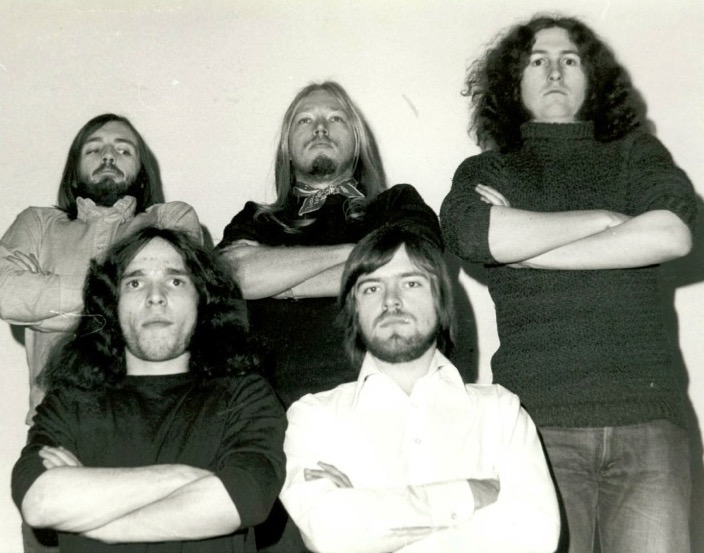
Front row: Anthony Minghella, Peter Markham
Misfits at Hull
“Bessie Love had been a star of Hollywood’s silent era. She must have been in her late seventies when she came with other actors to my school. Meeting such a luminary of the silver screen was for me a considerable treat. My parents had left school age 14. There were no writers, artists, teachers, no lawyers, journalists, no TV or film folk in my family. When I revealed to my mum that I wanted to get into TV, she had told me that I never could because “you don’t know the right people”. (Sadly, there’s still much truth in this, the Arts in the UK predominantly the domain of the privately educated and privileged.)
“So, when I asked Ms. Love if I might have a future in film and TV, she responded, to my surprise, with the words ‘Why not?’
“That was it! I had my permission. I also had another English teacher, Siân Nichols, a Drama graduate from Hull. Siân pointed me to Hull and, late in the day, I was granted an interview with both Drama and English faculties, which brought me, an inveterate southerner, north of London for the first time in my life.
“I was surprised, shortly after, to find myself admitted. Later I heard it said that the Drama Dept. actively sought not regular candidates but misfits.
“I had no doubt fitted the bill.”
Meeting Anthony
“Even before my first encounter with him, his driven determination was evident to me. I saw a note posted in the Student Union (notes were hard copy back then) advertising himself as a singer, keyboard player, and song writer looking for musicians for a band. It radiated confidence and unhesitating intention. I didn’t respond. Too timid.
“It must have been in meeting him in person— he had just arrived, a year behind me—that the topic of a putative band came up. Then I realized he was the one behind the posting, the one guilty of a hubris that in his case was justified. (If hubris ever can be justified, without no longer being hubris—over to Mike Walton, former Drama Dept tutor, for the answer.) I said I played guitar, had a Strat, a ’63, then I was in. Jim Crinson (French) joined on Hofner bass, Tony Fisher (Geography) on sax, and Rolf Grüninger from Baden-Württemberg on double drum kit. (I later worked with Rolf for a brief spell on the roads in Germany.)
“I think we gave a performance, maybe two, in the Student Union but most of the fun came with all-night, at-volume rehearsals in the University Boat Club hut. Martin Bostock, himself a worthy musician, would kindly drive me, my Selmer amp, Fuzz-Face and Vox Wah-Wah there and back—another token of his precious comradeship.
“Academe meanwhile continued, with Ant—I’m, proud to reveal—copying an essay or two of mine. He complained of getting a C, while I’d got an A+ sort of thing. But I guess Mike Walton, or whoever, might have recalled encountering those musings the first time around. Didn’t matter though. Ant went on to get a First.”
Poetry is not about pamphleteering, and neither is film.
Peter’s friendship with Anthony continued long after their student days, taking the pair from Hull to film sets across Europe and North Africa. Looking back on his career, one memory in particular remains especially significant.
“Along with highlights, I’d like to add significant moments, although there are too many to mention here. Perhaps the most painful, and to me the most important, occurred during a location scout for The English Patient in Tunis. The group of us, Anthony, his creative team, Line Producer, and Assistant Director, were standing on the street in what was a shockingly decaying slum, talking of possible blocking and camera placement for a scene, when I found my attention drawn to a group of children and a couple of dogs playing in the muck and filth opposite. For me, the conversation faded out and all I could think of was what I was looking at. I had to back away from the team to hide around the corner. I couldn’t stop the tears from flowing. Couldn’t stop the anger from boiling at the injustice. It was beyond anything I’d seen.
“Whenever I hear young filmmakers claim they want to make films to make the world a better place, I respond by telling them this is not the purpose or result of art, that they are disguising their ambition by false altruism. If they want to make the world a better place, they should work as a nurse, a carer, for Médecins Sans Frontières or some similar NGO, be a community organizer, or stand for office. All higher callings than working in Film and TV!
“James Baldwin said:
‘The purpose of art is to lay bare the questions which have been hidden by the answers.’
“Yes. Brings me back to Alan Bower, my tutor in the Engkish Dept. and his insights. Poetry is not a pamphleteer. And neither, I insist, is film.”
Misfits Rule
In the later years of our friendship, when he wrote my studio drama for the BBC Directing Course The Table, about a table that wouldn’t stop getting larger, when I supported him as his Production Manager and First Assistant Director on Truly, Madly, Deeply and as Second Unit Director on The English Patient, through the time he so generously had me live with him and his family in one of my no-home spells, and after, here in Los Angeles, Ant would say to me, would beg me to understand that: ‘You must do it now. There’s no time. You must do it now.’
What prescience. We lost him suddenly. He was 54.
I find it so reassuring that someone whose headmaster, I was many years after led to believe, had written on his reference that no one should on any account ‘accept this boy’ was to go on to Academic success, win the Evening Standard Young Playwright Award, and make a film that garnered nine—NINE!—Academy Awards.
From the boat club and Gulbenkian to the sands of the Sahara, and to Rome, Tuscany, Trieste with biplanes, tanks, with Ralph Fiennes and Juliette Binoche on English Patient, Anthony and I managed to get up to quite a lot.
Misfits rule! (One day, perhaps—I can only hope.)


Excellent, Peter. Nails the ethos of the time.
Mike Walton
LikeLike